

Intro
Augmented reality (AR) and virtual reality (VR) are changing the way graphic designers think about visual communication. Traditional graphic design has largely been created for two-dimensional surfaces such as screens, printed materials, packaging and advertising. AR and VR introduce something fundamentally different: visual communication can now occupy three-dimensional environments, respond to movement and interaction, and become part of an immersive experience rather than simply something an audience looks at. For graphic designers, this creates new opportunities to experiment with spatial typography, 3D graphics, interactive branding and visual storytelling.
The shift is already being supported by developments in creative software and immersive hardware. Adobe continues to expand its 3D, AR and VR ecosystem, while its 2026 Creative Trends research identifies immersive, multisensory visual experiences as an important part of the changing creative landscape. Adobe’s Substance 3D updates in 2026 have also focused on procedural workflows, OpenPBR, digital twins and faster 3D creation, demonstrating how traditional graphic design workflows are increasingly connecting with spatial and immersive production.
Lets Dive In
Graphic Design Is Moving Beyond the 2D Canvas
For decades, graphic designers have worked primarily within the boundaries of a rectangular canvas.
Posters, brochures, websites, social media graphics and digital advertisements all provide a defined visual surface. Designers control the relationship between typography, imagery, colour, shape and negative space within those boundaries.
AR and VR challenge this model.
An AR graphic can appear on top of the physical environment. A VR design can surround the user. A three-dimensional brand identity can exist as an object rather than a flat logo. Typography can occupy physical space, move around the user or respond to interaction.
This creates an expanded definition of graphic design.
The designer is no longer simply deciding where an element should appear on a page. They may need to decide where it should exist in a three-dimensional environment, how large it should appear, how users should encounter it and how it should respond to movement.
The result is a shift from visual composition towards spatial composition.
AR Turns Graphic Design Into an Environmental Experience
Augmented reality has particularly interesting implications for graphic designers because it overlays digital content onto the physical world.
A conventional poster might display a product image and a headline. An AR version could allow the viewer to point a smartphone or smart glasses at the poster and see a 3D representation of the product appear in the surrounding environment.
The graphic design therefore becomes an entry point into an experience.
Adobe’s own AR design guidance describes the combination of 2D and 3D assets as a way to extend existing graphic design skills into immersive experiences, including creating and texturing 3D assets and assembling brand elements within real-world environments.
This creates opportunities across advertising, packaging, retail, events, education and entertainment.
A product package could become interactive. A printed campaign could become a portal to a virtual experience. A brand identity could appear as a three-dimensional object rather than a static logo.
For graphic designers, the challenge is learning how to make these additional dimensions meaningful rather than simply adding technology for its own sake.
VR Creates Completely New Visual Environments
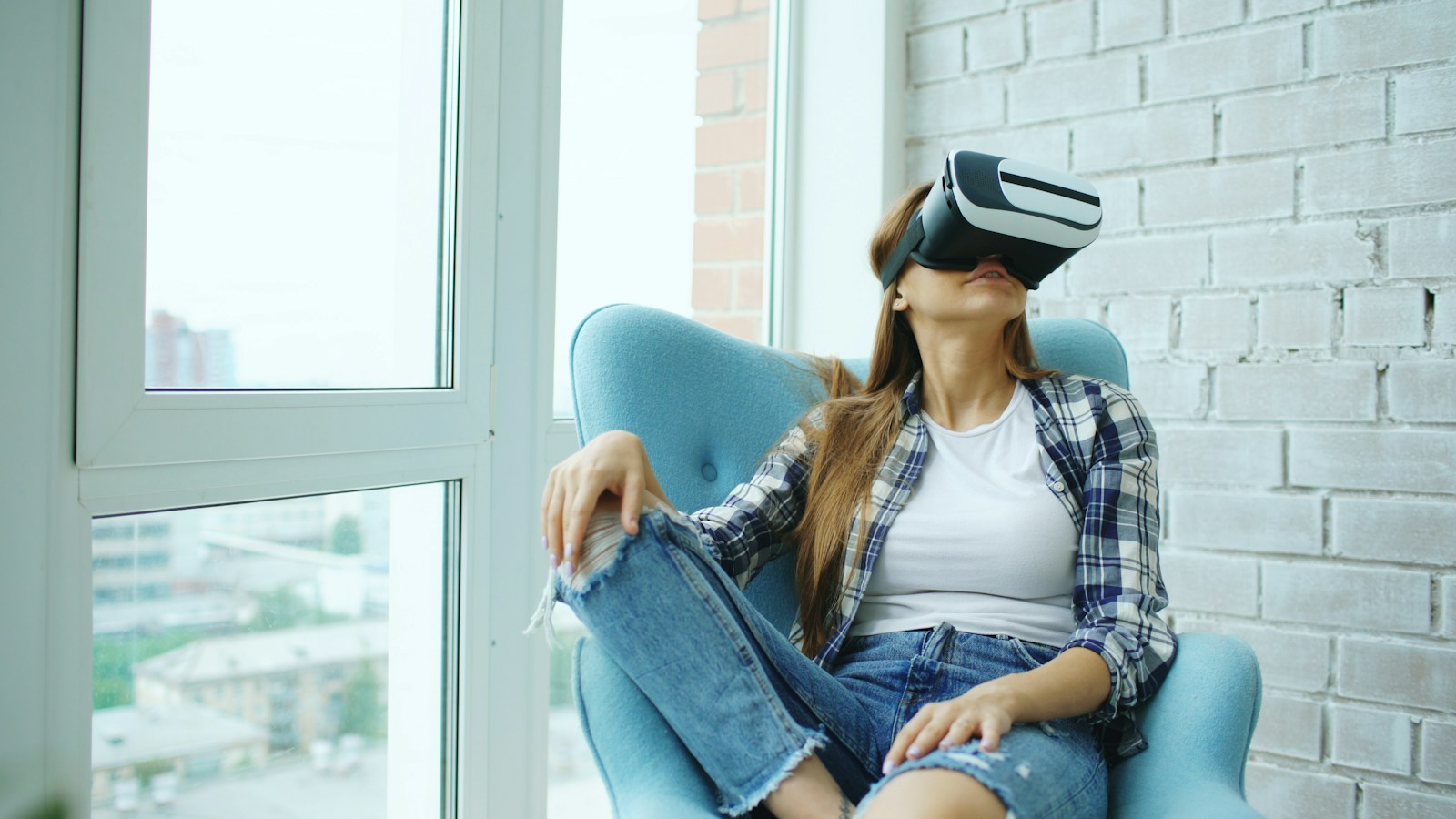
Virtual reality takes the concept even further because the designer controls the environment in which the user is immersed.
Instead of placing graphics onto a physical environment, designers can construct an environment from scratch.
This changes the role of composition.
In traditional graphic design, a viewer generally looks at a design from a relatively predictable position. In VR, the user can turn their head, move around, look behind objects and potentially interact with elements from different directions.
The designer therefore needs to think about 360-degree visual storytelling.
A visual element that works perfectly from one viewpoint may be irrelevant when the user moves elsewhere.
This means VR graphic design increasingly overlaps with environmental design, motion design, UX design, animation and 3D modelling.
Spatial Design Is Becoming a New Graphic Design Skill
Spatial design involves organising visual elements within three-dimensional space.
For graphic designers, this introduces questions that are less important in conventional 2D work.
How far away should a visual element appear?
How large should it be?
Should it remain fixed in the environment or follow the user?
How should typography behave when viewed from different angles?
How should colour work under different lighting conditions?
How should users know that an object is interactive?
These questions require designers to think about perception and movement as well as visual appearance.
Coursera’s current UX material for AR designers highlights concepts including presence, agency, affordance, field of view, 2D versus 3D interfaces, interaction patterns and user testing within immersive environments.
This illustrates how AR/VR design is expanding beyond conventional graphic design principles.
Typography Is Being Reimagined for AR and VR
Typography is one of the areas most significantly affected by immersive design.
Traditional typography assumes that text exists on a flat surface. AR and VR allow text to occupy three-dimensional space.
A heading could appear as a floating object. A brand message could wrap around a virtual structure. Information could appear at different depths within an environment.
However, this does not mean that every traditional typographic principle becomes irrelevant.
Readability remains essential.
Designers must consider font size, contrast, spacing, viewing distance and the amount of text presented at one time.
Immersive environments can make typography more engaging, but they can also make it more difficult to read.
The best AR/VR typography therefore combines traditional graphic design discipline with an understanding of spatial perception.
3D Graphics Are Becoming Part of the Graphic Designer’s Toolkit
The increasing importance of 3D is one of the clearest changes occurring within modern graphic design.
Designers can now create objects, materials and environments that can be used across advertising, product visualisation, AR, VR, games and digital experiences.
Adobe’s 2026 Substance 3D updates illustrate the direction of the industry. The company introduced expanded OpenPBR support, procedural modelling improvements and a growing library of 3D materials and models. Adobe also highlighted digital twin workflows that connect product design, visualisation and 3D production.
This means graphic designers increasingly have access to tools that allow them to move naturally between 2D and 3D workflows.
The transition does not necessarily require designers to become specialist 3D artists overnight.
Instead, basic knowledge of modelling, materials, lighting, cameras and real-time rendering can expand the range of visual concepts they can develop.
AR/VR Is Changing Visual Storytelling
Traditional graphic design often communicates a message through a carefully controlled sequence.
A poster presents an image, headline and supporting information. A website guides users through a hierarchy of content. A brochure establishes a visual narrative across pages.
Immersive design changes the relationship between creator and audience.
The user can determine where to look and, in some experiences, what to do next.
This means designers increasingly need to think about interactive visual storytelling.
Instead of asking only what the audience should see, designers need to consider what the audience should experience.
A VR campaign might begin with a wide environmental scene before directing attention towards a particular object. An AR experience might reveal additional information only when a user approaches or interacts with a specific element.
Visual storytelling therefore becomes dynamic.
From Visual Hierarchy to Spatial Hierarchy
Graphic designers are familiar with visual hierarchy.
Size, colour, contrast, positioning and typography can establish which elements receive attention first.
In AR and VR, these principles remain relevant but are joined by spatial relationships.
Depth can influence importance.
Movement can attract attention.
Sound can reinforce a visual cue.
Proximity can indicate relationships between objects.
The designer therefore has more tools for directing attention but also more variables to manage.
This makes immersive graphic design considerably more multidisciplinary.
The designer may need to collaborate with UX designers, 3D artists, developers, animators and sound designers to create a coherent experience.
Immersive Branding Could Redefine Brand Identity
Brand identity has traditionally revolved around logos, colours, typography, imagery and graphic systems.
AR and VR allow brands to develop identities that behave as experiences.
A brand could have a distinctive three-dimensional environment, interactive logo animation, spatial typography or virtual product showroom.
The identity could change depending on how the user interacts with it.
This introduces the idea of dynamic brand identity.
Instead of a logo always appearing in exactly the same form, a brand system could have rules governing how it behaves in immersive environments.
The challenge is maintaining recognition.
The more flexible the identity becomes, the more important it is to establish consistent visual characteristics.
Colour, shape, motion, typography and tone can provide continuity across different immersive experiences.
AR Is Expanding Product Visualisation
Product design is another area where AR and graphic design increasingly intersect.
A traditional product advertisement provides a fixed representation.
AR can allow customers to see how an object might look within their own environment.
Furniture, vehicles, consumer electronics, fashion and interior products can all benefit from spatial visualisation.
For designers, this means creating graphics that do more than communicate appearance.
They need to communicate scale, context and physical relationships.
Adobe’s 2026 work around digital twins illustrates the broader direction of this technology. Digital twins can allow products to be visualised digitally before or alongside physical production, supporting richer product visualisation and customer experiences.
This expands the potential role of graphic designers within product marketing and visual communication.
Virtual Environments Are Becoming Creative Canvases
VR environments can function as giant creative canvases.
Instead of designing a poster that occupies a few square metres, a designer can create an entire virtual world.
This creates opportunities for exhibitions, virtual events, education, entertainment, retail and brand experiences.
A museum could recreate historical environments. A company could create a virtual showroom. A fashion brand could build an immersive campaign environment. An educational organisation could create an interactive historical experience.
In each case, graphic design contributes to the visual language of the environment.
Colour palettes, signage, typography, objects, textures and visual symbols all contribute to the user’s understanding of the virtual space.
Graphic designers therefore become increasingly involved in world-building.
The Importance of Motion in Immersive Graphic Design
Static graphics remain important, but AR and VR introduce movement as a fundamental design element.
Objects can animate when users approach them. Typography can transform. Logos can assemble themselves. Environmental elements can respond to interaction.
Motion therefore becomes part of the visual identity.
This creates opportunities for designers who understand motion graphics.
The combination of graphic design, animation and immersive technology can produce experiences that are considerably more expressive than static imagery.
However, motion also needs restraint.
Excessive animation can distract users or make navigation confusing.
The best immersive experiences use movement to communicate purpose rather than simply to demonstrate technological capability.
Designers Must Think About User Attention Differently
In traditional graphic design, attention can often be guided through composition.
A designer decides what appears at the top of a page, what is largest and what receives the strongest contrast.
Immersive environments are less predictable.
Users can look in another direction.
They can ignore the intended focal point.
They can move away from an important element.
This means designers need new techniques for directing attention.
Lighting, animation, sound, spatial positioning and environmental contrast can all influence where users look.
The designer’s role becomes partly one of attention choreography.
Accessibility Becomes Even More Important
Immersive graphic design also introduces significant accessibility considerations.
Not everyone experiences AR and VR in the same way.
Visual limitations, motion sensitivity, hearing differences, physical mobility and cognitive considerations can affect how users interact with immersive environments.
Designers therefore need to consider alternatives and accessibility from the beginning.
Text must remain readable. Important information should not depend exclusively on colour. Motion should be controlled appropriately. Navigation should be understandable.
Immersive technology should expand access to experiences rather than create unnecessary barriers.
This reinforces the value of user-centred design principles within AR and VR.
AR/VR Is Encouraging Designers to Learn 3D
One of the clearest implications for graphic designers is the increasing value of 3D skills.
Traditional graphic design professionals who learn 3D modelling, texturing and lighting can create assets that move across multiple environments.
A single 3D object might appear in a product advertisement, AR experience, virtual showroom, social campaign or interactive website.
This makes 3D knowledge increasingly valuable.
Adobe’s Substance 3D ecosystem is explicitly positioned around this intersection between 3D design, AR, VR and visualisation. Its current tools include procedural material creation, 3D assets and workflows designed to connect different stages of 3D production.
For graphic designers, learning 3D therefore does not necessarily mean abandoning existing skills.
It can be viewed as an extension of them.
The Rise of Real-Time 3D Workflows
Real-time rendering is also changing the design process.
Traditional graphic design often relies on static exports.
AR and VR environments need assets that can respond dynamically to the user’s position and actions.
This creates greater demand for optimised models, textures and materials.
Designers working in immersive environments therefore need to understand performance as well as appearance.
A highly detailed asset may look excellent in a still image but perform poorly inside a real-time application.
This introduces another design constraint.
The designer needs to achieve an appropriate balance between visual quality and technical performance.
AI Is Accelerating AR/VR Graphic Design
Artificial intelligence is likely to accelerate the convergence between graphic design and immersive technology.
AI can already assist with image generation, concept development and creative exploration.
Combined with 3D workflows, AI could make it easier for designers to explore environments, textures, materials and visual styles.
Adobe’s 2026 Creative Trends research specifically identifies AI-supported creativity alongside immersive visual experiences, while its Substance 3D ecosystem is being developed around faster and more connected workflows.
This could make immersive design more accessible to designers who do not have extensive technical backgrounds.
Instead of manually creating every 3D element, designers may increasingly use AI to generate starting points and then refine them using traditional creative skills.
The designer’s role becomes increasingly focused on direction, selection and refinement.
Will AR/VR Replace Traditional Graphic Design?
AR and VR are unlikely to replace conventional graphic design.
Most visual communication will continue to exist on screens, printed materials and traditional digital platforms.
Instead, immersive technologies are expanding the range of environments in which graphic design can operate.
The important change is that graphic designers now have more opportunities to create experiences rather than simply images.
A logo can become an interactive object.
A poster can become an AR trigger.
A product illustration can become a 3D model.
A brand campaign can become a virtual environment.
This represents an expansion of graphic design rather than its disappearance.
What Skills Will Graphic Designers Need?
Graphic designers interested in AR and VR should increasingly develop a combination of traditional and emerging skills.
Strong foundations in typography, colour theory, composition, branding and visual storytelling remain essential.
Alongside these, designers can benefit from learning 3D modelling, texturing, lighting, animation, spatial design, UX and immersive interaction.
Understanding real-time engines can also be useful, particularly for designers working on advanced VR environments.
The most valuable skill may ultimately be the ability to connect these disciplines.
A designer who understands both traditional visual communication and immersive interaction can contribute to projects from the initial concept through to the final experience.
Recommended Online Courses to Build AR/VR Graphic Design Skills in 2026
As graphic design expands into immersive environments, developing skills in 3D modelling, XR experience design and visual storytelling can help designers adapt to new creative workflows. The following courses provide relevant practical training and strong learner demand, with ratings and enrolment figures checked in 2026.
Complete Blender Creator: 3D Modelling — Udemy
Platform: Udemy
Level: Beginner to Intermediate
Focus: 3D modelling, materials, UV mapping, animation and visualisation
Complete Blender Creator: 3D Modelling is a Bestseller course from the GameDev.tv team, Rick Davidson and Grant Abbitt. It had a 4.8/5 rating from more than 69,000 ratings and over 354,000 students when checked, with the course updated in February 2026. The curriculum covers Blender fundamentals, modelling, materials, UV mapping, animation and the creation of complete 3D assets.
For graphic designers moving towards AR and VR, Blender provides a practical foundation for creating the three-dimensional objects and environments that increasingly form part of immersive visual communication.
Course Link: Complete Blender Creator: 3D Modelling — Udemy
Learn Blender 3D Modeling for Unity Video Game Development — Udemy
Platform: Udemy
Level: Beginner to Intermediate
Focus: 3D assets, environments, materials, animation and real-time workflows
Learn Blender 3D Modeling for Unity Video Game Development is a Bestseller and Highest Rated course with a 4.8/5 rating from more than 2,100 ratings and around 16,000 students when checked. It was updated in June 2026 and covers game-ready 3D assets, environments, materials, UV mapping, animation and optimisation for Unity.
The course is relevant to graphic designers because it introduces the production requirements involved when visual assets move from a traditional design environment into interactive real-time experiences.
Course Link: Learn Blender 3D Modeling for Unity Video Game Development — Udemy
Introduction to Augmented Reality and ARCore — Coursera
Platform: Coursera
Level: Beginner
Focus: AR design, 3D assets, UX, virtual environments and Unity
Introduction to Augmented Reality and ARCore is offered by Google AR & VR and had 101,351 learners enrolled and a 4.5/5 rating from 3,896 reviews when checked. The four-module course covers AR concepts, user flows, 3D assets, virtual environments and building an AR experience using ARCore and Unity.
For graphic designers, the course provides an accessible introduction to how visual design moves into augmented reality and how 2D design principles interact with 3D assets, user experience and interactive environments.
Course Link: Introduction to Augmented Reality and ARCore — Coursera
Final Thoughts
AR and VR are expanding graphic design from a discipline focused primarily on two-dimensional visual communication into one increasingly concerned with space, interaction, movement and immersive storytelling.
The technology is still developing, and adoption will vary significantly between industries. However, the direction of creative software provides a strong signal. Adobe’s continued investment in Substance 3D, OpenPBR, procedural workflows and digital twins demonstrates that 3D creation is becoming increasingly integrated with mainstream creative production.
At the same time, Adobe’s 2026 Creative Trends research identifies immersive and multisensory visual experiences as part of the changing creative landscape, suggesting that audiences and brands are becoming more interested in visual experiences that extend beyond conventional static formats.
For graphic designers, this creates an opportunity to rethink what visual communication can be.
The future design canvas may not always be a screen.
It could be a room, a retail environment, a virtual world, a product, a pair of smart glasses or an interactive three-dimensional space.
Designers who understand how to adapt typography, colour, branding, composition and storytelling to those environments will be able to work across a much broader creative landscape.
AR and VR are therefore not simply adding another technology to graphic design. They are changing the fundamental relationship between designer, visual content and audience.
The graphic designer of the future may increasingly need to think not only about what people see, but where they see it, how they interact with it and how the visual story unfolds around them.