

Intro
Augmented reality (AR) and virtual reality (VR) are changing how consumers discover, evaluate and purchase products online. In 2026, eCommerce businesses are increasingly using immersive shopping technologies to help customers visualise furniture in their homes, try on virtual clothing and eyewear, explore three-dimensional product models and experience digital showrooms. Tools from Shopify, Zakeke and specialist 3D commerce providers are making these experiences more accessible, while advances in mobile cameras, AI-powered virtual try-ons and browser-based 3D rendering are reducing the barriers to adoption. By bringing aspects of the physical shopping experience into digital storefronts, retailers can address one of eCommerce’s longstanding challenges: helping customers feel confident about products they cannot physically examine before buying.
The growing adoption of AR/VR shopping tools reflects a wider shift towards interactive, personalised and customer-centred online retail. Consumers increasingly expect more than static product photographs, particularly when purchasing expensive furniture, fashion, cosmetics or configurable products. Immersive shopping can improve product understanding, encourage engagement and potentially increase conversion rates while reducing returns caused by unmet expectations. However, these benefits are not automatic. Businesses must consider technology costs, product modelling, device compatibility, user experience and the commercial return on investment (ROI). Combining immersive commerce technology with skills development in digital marketing, eCommerce analytics, 3D content creation and customer experience design can help businesses compete more effectively in 2026.
Lets Dive In
What Are AR and VR Shopping Tools?
Augmented reality shopping overlays digital products or information onto the customer’s real-world environment. Using a smartphone or tablet camera, shoppers can place a virtual sofa in their living room, preview a lamp on a desk or see how glasses look on their face. The experience helps customers assess scale, appearance and suitability before making a purchase.
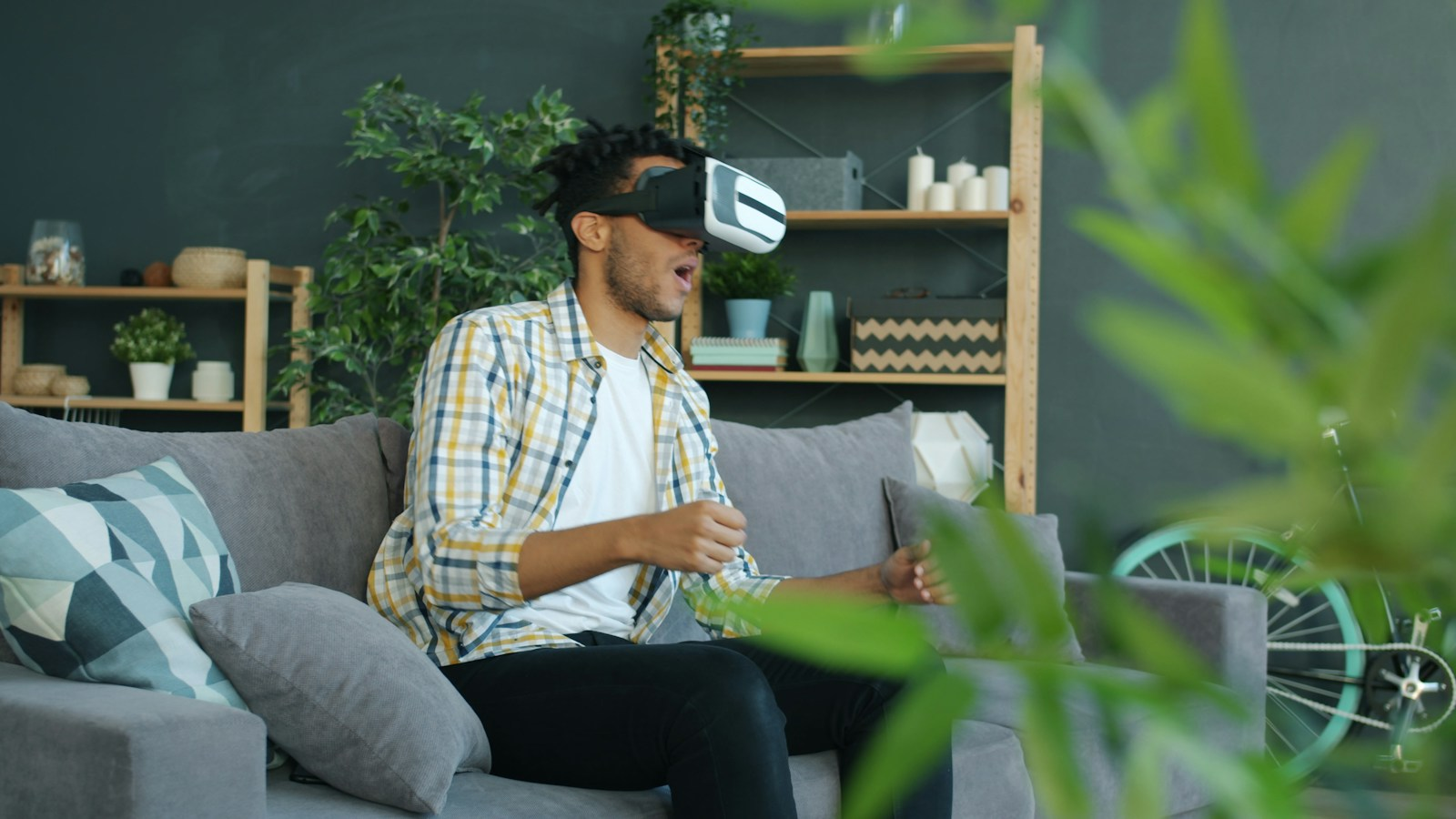
Virtual reality shopping takes immersion further by placing customers inside a digitally created environment. A shopper might explore a virtual showroom, browse products arranged within a simulated retail space or attend an immersive product demonstration. VR generally requires a compatible headset for the fullest experience, although some virtual environments can also be explored through conventional screens.
Three-dimensional product visualisation sits between traditional product photography and more immersive experiences. Customers can rotate an item, zoom in on details, change colours and inspect different angles directly on a product page. Although 3D visualisation does not always involve AR or VR, it often provides the digital assets needed to create these experiences.
These technologies are increasingly connected with artificial intelligence, product configurators and personalisation tools. A customer might customise a product’s colour, material and dimensions before viewing the result in 3D or placing it in their environment through AR.
For retailers, the objective is not simply to create an impressive visual experience. It is to give customers useful information that supports purchase decisions, reduces uncertainty and makes online shopping more convenient.
The Best AR/VR Shopping Tools Transforming eCommerce in 2026
Shopify AR: Bringing Products into Customers’ Homes
Shopify provides eCommerce infrastructure that supports 3D product media and augmented reality experiences on compatible storefronts. Retailers can use supported 3D models to let customers examine products interactively and, on compatible devices, view them in their own surroundings.
This is particularly valuable for furniture, home décor, accessories and other products where size, shape and appearance influence purchase decisions. Instead of estimating whether a chair will fit beside a dining table, customers can use AR to understand its scale in their actual space.
Shopify’s guidance on 3D eCommerce describes how interactive product models and AR can improve product discovery and help shoppers make more informed purchasing decisions.
The platform is attractive to small and medium-sized retailers because immersive product media can be integrated into an existing online store rather than requiring an entirely separate virtual shopping environment. However, retailers still need suitable 3D assets, an effective product page and compatible customer devices.
The best results are likely to come from applying AR to products where visual uncertainty is a genuine barrier to purchase, rather than adding it indiscriminately to every item in a catalogue.
Zakeke: 3D Product Customisation and Virtual Try-On
Zakeke provides a visual commerce platform that supports 3D product configuration, AR visualisation, customisation and virtual try-on experiences.
Its product configurators allow shoppers to explore different product variants, including colours, materials and design options, and see the results visually before placing an order. This can be useful for personalised furniture, jewellery, promotional merchandise, fashion accessories and made-to-order products.
For example, a customer purchasing a personalised desk could choose a finish and configuration, inspect the result in 3D and use AR to understand how the finished product might look in a home office. This reduces the gap between the product description and the customer’s expectations.
Zakeke also offers integrations with eCommerce systems, including Shopify, WooCommerce and BigCommerce. Its visual commerce features illustrate how retailers can combine customisation and immersive product presentation.
The main consideration is the quality of the underlying product models and configuration rules. If a virtual product does not accurately represent its real-world dimensions, materials or available options, the experience may create unrealistic expectations.
Threekit: Interactive 3D Product Configurators
Threekit specialises in 3D product visualisation, configurators and immersive commerce experiences.
Its approach is particularly relevant to retailers selling products with many variations. Furniture manufacturers, for example, may offer different upholstery materials, frame finishes, dimensions and optional components. Photographing every possible combination can be expensive and time-consuming.
A 3D configurator allows customers to change selected attributes and see the resulting product visually. Depending on the implementation, the experience can connect product configuration with pricing, product information and sales workflows.
This can improve the customer journey by helping buyers understand what they are purchasing before committing to an order. It may also reduce the production burden associated with maintaining large libraries of product photography.
Threekit is generally more relevant to businesses with substantial product catalogues, complex configurations or a need for sophisticated visual commerce. Smaller retailers should assess whether a specialist implementation is justified by their product complexity and sales volumes.
Google ARCore: Supporting Mobile Augmented Reality
Google ARCore provides technology that enables developers to build augmented reality experiences for supported Android devices and other compatible environments.
Its capabilities support features such as environmental understanding, motion tracking and placing digital objects within a real-world scene. These functions are important when shoppers need to see a virtual product at a realistic scale and position.
For an eCommerce retailer, ARCore may form part of a custom shopping application or a wider AR implementation. A furniture business could use AR functionality to help customers position virtual products in their homes, while a product brand might develop an interactive demonstration that explains how an item works.
ARCore is a development platform rather than a complete ready-made eCommerce solution. Businesses typically need suitable 3D assets, a compatible application or integration and technical expertise to create a polished shopping experience.
For organisations seeking a simpler starting point, browser-based product viewers and established eCommerce integrations may be more practical than building a bespoke AR application from scratch.
Snapchat and Virtual Try-On Experiences
Snapchat for Business provides augmented reality advertising and interactive Lens experiences that brands can use to engage customers.
AR Lenses can allow shoppers to preview certain products, explore branded experiences or try virtual versions of accessories and beauty products. This creates a connection between discovery on social platforms and subsequent product consideration.
For fashion, beauty and accessories brands, virtual try-on can help customers explore styles and share their experiences. A shopper might preview different looks before visiting a retailer’s product page to complete a purchase.
The commercial advantage is that AR can become part of the discovery process rather than remaining confined to the online store. Interactive experiences can encourage product exploration and create opportunities for customers to share branded content.
However, brands should evaluate whether the experience attracts relevant shoppers and contributes to measurable outcomes. High engagement or large numbers of Lens interactions do not necessarily translate into profitable sales.
Virtual Showrooms and VR Shopping Environments
VR shopping environments allow retailers to recreate aspects of physical retail in a digital space. Customers may browse products in a virtual showroom, examine selected items or explore a brand’s visual identity through an immersive environment.
Fashion, luxury, interior design and specialist retail businesses may find this approach useful when the experience itself contributes to the brand’s value. Virtual showrooms can also support product demonstrations and remote sales presentations.
However, VR adoption faces greater barriers than smartphone-based AR. Customers may need a compatible headset, additional time and a willingness to navigate a less familiar shopping environment. Some virtual stores can be accessed through ordinary screens, but the level of immersion is reduced.
For most retailers, VR is best treated as a targeted experience rather than a universal replacement for conventional online shopping. It is most valuable when immersion adds something meaningful that product photography, 3D viewers or AR cannot provide as efficiently.
Why AR/VR Shopping Tools Are Gaining Traction in 2026
Consumers Want Greater Purchase Confidence
One of the main reasons immersive commerce is gaining attention is that customers cannot physically handle products when shopping online. Photographs may not fully communicate an item’s scale, texture, appearance or compatibility with an existing environment.
AR and 3D visualisation help close this information gap. A shopper can inspect a product from different angles, while a virtual try-on can provide a better sense of how an item might look when worn.
Shopify’s 2026 guide to augmented reality in eCommerce discusses the role of immersive product experiences in improving purchase confidence.
The benefit is especially relevant to products with a high perceived purchase risk. Customers buying furniture, eyewear, home accessories or expensive products may need additional reassurance before committing.
Smartphone Technology Makes AR More Accessible
AR shopping no longer necessarily requires a specialist headset. Many experiences can run through compatible smartphones and tablets, allowing retailers to reach customers using devices they already own.
This accessibility makes AR easier to incorporate into conventional eCommerce journeys. A customer can discover a product, open an AR viewer and return to the checkout without leaving the shopping experience for a separate physical store.
Browser-based technologies and established commerce integrations also help reduce the need for customers to download dedicated applications.
Nevertheless, device compatibility, camera permissions, lighting conditions and connection quality can affect the experience. Retailers should make sure that customers who cannot use AR still have access to clear product photographs, dimensions and detailed descriptions.
AI Is Improving Virtual Try-On and Product Visualisation
AI is helping retailers develop more flexible product experiences, particularly in fashion, beauty and visual merchandising.
AI-powered virtual try-on systems can generate previews of products on customer images or avatars, while automated workflows may help prepare product content and manage large catalogues of visual assets.
These capabilities could reduce some of the production effort involved in creating immersive shopping experiences. However, generated images must be evaluated for accuracy, particularly when fit, colour, product construction or material appearance affects the purchase decision.
Retailers should also consider privacy and consent when customer images or body-related data are processed. Clear explanations of how information is used help maintain trust.
Retailers Need Better Ways to Differentiate Their Online Stores
Online shoppers can compare prices and products across numerous retailers within minutes. Immersive product experiences offer another way to demonstrate value beyond price competition.
A furniture retailer that allows customers to visualise products in their homes can provide a more useful experience than a competitor relying exclusively on static photographs. A cosmetics brand offering effective virtual try-on can help customers explore colours and styles before buying.
These experiences may also strengthen brand recall and encourage product discovery. However, the advantage depends on whether the technology solves a genuine customer problem rather than merely adding novelty.
Customer Adoption: Who Uses AR/VR Shopping and Why?
Customer adoption varies by product category, audience, device access and the usefulness of the experience.
Furniture and home décor are natural applications because customers need to understand product dimensions and how items fit within existing spaces. Eyewear and cosmetics benefit from virtual try-on, while fashion and footwear can use immersive tools to support style exploration and product discovery.
Adoption also depends on ease of use. Customers are more likely to experiment with AR when the feature is easy to find, loads quickly and does not require a complicated setup. A clearly labelled option such as “View in your room” or “Try it on” communicates the benefit more effectively than an unexplained technology icon.
Retailers should avoid assuming that all customers want immersive experiences. Some shoppers prefer conventional product photography, detailed specifications and fast checkout. AR/VR should complement these options rather than obstruct them.
A useful implementation strategy is to test immersive features with products where uncertainty is highest, then compare engagement and purchasing behaviour with similar products that do not offer the feature.
Measuring ROI: Can AR/VR Shopping Increase Sales?
The return on investment from AR/VR shopping depends on whether the experience improves customer outcomes enough to justify the costs of development, integration, content creation and maintenance.
Potential benefits include higher conversion rates, more product interactions, improved average order value, fewer product returns and reduced demand for physical samples or repeated product photography. The relative importance of these benefits varies by industry.
Shopify’s published examples include Rebecca Minkoff, where shoppers who interacted with 3D product models showed higher add-to-cart activity, and Oakywood, which reported substantial changes in average order value across several markets after introducing 3D product experiences alongside other business changes. These are individual business examples, not guaranteed results for every retailer. Shopify’s 3D eCommerce guide provides further context.
An Illustrative ROI Calculation
Consider an online furniture retailer receiving 20,000 product-page visits per month. Suppose the store has a baseline conversion rate of 2%, producing 400 orders. If an AR implementation improves the conversion rate to 2.2%, the store would generate 440 orders from the same traffic, assuming the change is attributable to the feature and other factors remain constant.
If the average order value is $174, the additional 40 orders represent $6,960 in monthly revenue. If the retailer’s contribution margin after variable costs is 35%, that equates to $2,436 in additional monthly contribution before the cost of the AR system.
Suppose the implementation and operating costs average $1,160 per month when setup costs are spread across the evaluation period. The illustrative net monthly contribution would be $1,276.
These figures are hypothetical and do not represent a forecast. The calculation also assumes that the conversion improvement is sustained and that the additional orders do not generate offsetting costs such as increased returns or customer service demand.
A retailer should use its own traffic, conversion, margins and implementation costs to evaluate the business case.
Tracking the Metrics That Matter
Useful AR/VR performance indicators include feature engagement, add-to-cart rate, conversion rate, average order value, product returns and contribution margin.
Retailers should compare customers who interact with immersive product features with appropriate comparison groups, ideally using controlled experiments where possible. This helps distinguish the effect of AR from differences in customer intent or product popularity.
Return rates deserve particular attention. If AR helps customers understand dimensions or appearance more accurately, it may reduce some returns caused by mismatched expectations. However, the effect must be measured, and a virtual preview cannot guarantee that a customer will be satisfied with the physical product.
Businesses should also measure technical performance. Slow-loading 3D models, confusing controls or poor mobile compatibility can undermine the customer experience and reduce the potential benefits.
Costs and Implementation Challenges
AR/VR shopping tools range from relatively accessible product viewers to sophisticated custom applications and immersive virtual stores.
Costs depend on the number of products, complexity of 3D models, level of customisation, integration requirements and ongoing support. A retailer with a small collection of simple products may be able to start with a limited set of 3D assets, while a furniture brand with thousands of configurations may require a more substantial visual commerce system.
Product modelling can be one of the most important costs. Models must accurately represent dimensions, proportions and relevant visual details. Poor-quality assets may undermine customer confidence and create misleading expectations.
Performance is another concern. Large 3D files can slow product pages, particularly on mobile connections. Retailers should optimise assets, test on different devices and provide conventional product images as a fallback.
Privacy, accessibility and user experience also matter. Customer-facing AR features should explain camera permissions clearly, while VR environments should offer alternatives for shoppers who cannot or do not wish to use headsets.
The most effective approach is to start with a focused pilot, test the experience with real customers and expand only when the commercial benefits justify the additional investment.
Skills Development: Learning to Build Better Immersive Shopping Experiences
As immersive commerce develops, eCommerce professionals need a combination of commercial, creative and technical skills.
Digital marketing and customer experience design help businesses identify where AR/VR can remove purchase barriers. Analytics skills enable teams to measure conversion, engagement and returns. Product content knowledge helps ensure that immersive models accurately represent real products.
For those developing the experiences themselves, 3D modelling, Unity, ARCore and product visualisation skills can provide a foundation for building interactive shopping tools. Understanding mobile performance, interface design and accessibility is also important.
Online learning offers a flexible way to acquire these skills without requiring a full-time return to education. Learners can start with an introductory AR course, build a small prototype and then progress to 3D asset creation or immersive application development.
The strongest projects are tied to real commercial questions. For example, a learner might create a simple AR product demonstration, design a virtual try-on concept or build a dashboard to measure engagement and conversion. These projects can demonstrate both technical capability and an understanding of business outcomes.
Recommended Online Courses to Build AR/VR eCommerce Skills in 2026
The following three courses cover complementary aspects of immersive commerce, from AR fundamentals to practical business applications and 3D product development. They are offered by three different learning platforms.
Make Augmented Reality Mobile Apps with Unity & Vuforia 2026 — Udemy
Platform: Udemy
Level: Beginner to intermediate
Focus: AR application development, Unity, Vuforia and interactive 3D assets
This practical course is a useful option for learners who want to understand how augmented reality applications are assembled and deployed to mobile devices. The available listing identifies it as a Highest Rated course and reports a rating of 4.5 out of 5 from 252 ratings, with more than 23,000 students. The listing states that it was updated in June 2026.
The course covers setting up the development environment, working with 3D models and building AR experiences using Unity and Vuforia. Although its examples are not exclusively focused on online retail, the underlying skills are relevant to product demonstrations, interactive marketing and mobile AR shopping concepts.
Learners can use the training to understand how digital objects are incorporated into real-world views and how interactive experiences are deployed. This is particularly useful for aspiring AR developers, digital entrepreneurs and eCommerce professionals who want to collaborate more effectively with technical teams.
Introduction to Augmented Reality and ARCore — Coursera
Platform: Coursera
Level: Beginner
Focus: AR fundamentals, mobile experiences, 3D assets and user experience
Developed by Google AR & VR, this course provides an accessible introduction to augmented reality and the technology behind ARCore. The available listing reports a rating of 4.5 out of 5 from approximately 3,900 reviews, with more than 100,000 enrolled learners.
The course explores how AR works, the role of mobile hardware, environmental understanding, tracking, placing virtual objects and designing effective AR experiences. It also introduces tools and approaches for developing AR applications.
For eCommerce professionals, these concepts help explain why scale, positioning, lighting and device compatibility affect the quality of virtual product previews. Understanding these fundamentals can support better decisions when evaluating an AR provider or planning an immersive shopping project.
The course is suitable for beginners who want to understand the technology before progressing into more advanced development or implementation work.
Using Augmented and Virtual Reality in Sales — LinkedIn Learning
Platform: LinkedIn Learning
Level: Beginner to intermediate
Focus: AR/VR in sales, virtual demonstrations, customer engagement, costs and risks
This concise course explores how augmented and virtual reality can be applied to sales processes and customer experiences. The listing describes practical applications including virtual product demonstrations, immersive experiences and AR-enabled engagement.
It also examines potential adoption risks and costs, helping learners consider the commercial implications of introducing immersive technology rather than focusing exclusively on the technical features.
For eCommerce professionals, the course is relevant to planning virtual product demonstrations, evaluating customer engagement opportunities and explaining the business case for AR/VR investments. It can help marketers and sales teams connect immersive experiences with customer needs and measurable commercial outcomes.
The course is particularly suitable for people who influence technology purchasing decisions or need to understand how immersive tools fit into a broader sales and marketing strategy.
Access the course on LinkedIn Learning
The Future of AR/VR Shopping Experiences
AR/VR shopping is likely to become increasingly integrated with eCommerce product pages, mobile shopping experiences, AI-powered recommendations and personalised product configuration. As 3D content creation becomes more accessible, a wider range of retailers may be able to experiment with immersive product experiences without developing expensive standalone applications.
AI could also help shoppers compare products, explore different configurations and understand how items might fit their preferences or environments. At the same time, retailers will need to protect customer privacy, ensure that virtual representations are accurate and avoid creating experiences that add friction to the buying process.
Adoption will remain uneven across product categories. Smartphone-based AR and 3D product viewers are likely to remain more practical for many retailers than requiring customers to enter dedicated VR environments. The best approach will depend on whether immersion solves a meaningful customer problem.
Businesses that combine effective product visualisation with strong eCommerce fundamentals, careful experimentation and appropriate skills development will be better placed to benefit from these technologies.
Final Thoughts
AR/VR shopping tools are changing eCommerce by helping customers interact with products before buying, visualise items in real environments and explore more personalised shopping experiences. Platforms such as Shopify, Zakeke, Threekit, Google ARCore and Snapchat illustrate the range of options available, from accessible 3D product viewers to custom configurators and immersive digital environments. Their potential benefits include stronger purchase confidence, increased engagement, improved conversion and fewer returns caused by mismatched expectations.
However, immersive commerce delivers value only when the experience is useful, technically reliable and commercially justified. Retailers should focus on products where visual uncertainty affects buying decisions, test customer adoption and calculate ROI using their own conversion, margin and return data. Online learning in AR development, 3D modelling, customer experience design and sales strategy can help professionals develop the skills required to implement these tools effectively. In 2026, the strongest eCommerce experiences will combine immersive technology with accurate product information, accessible design and a clear understanding of what helps customers buy with confidence.